
Choosing Colour Schemes for Small Bathroom Spaces
Why Light Neutrals Do So Much Heavy Lifting
A typical bathroom in a British terrace or a 1930s semi lands somewhere between four and six square metres, with one small window and a ceiling around 2.4 metres. In a room that size, every surface you paint or tile is doing optical work whether you intend it to or not. Light neutrals — soft ivories, pale greiges, muted chalk whites — bounce more of the available daylight back into the room, so the walls recede instead of closing in.
What matters far more than how pale a colour is, though, is its undertone. A cool, blue-based white on the walls of a north-facing bathroom will read grey and slightly clinical all year round, and no amount of clever lighting will warm it up convincingly. A white with a touch of yellow, pink or cream will feel welcoming even on a dull February morning. South-facing rooms can carry cooler tones without turning gloomy. If you are unsure which way yours faces, spend a Saturday in it and note when the light actually arrives and how long it lingers.
Choosing the Right Kind of Neutral
Neutrals are not one category, and the differences between them are what make or break a compact scheme.
- Warm off-whites — forgiving, flattering to skin tones in mirror light, and excellent with brass or bronze fittings.
- Greiges and soft taupes — add depth without heaviness, and hide everyday splash marks better than pure white.
- Pale blues, sages and misty greens — still light, but they introduce a little colour so the room feels designed rather than default.
- Pure brilliant white — best kept for ceilings and trim, where its slight starkness reads as crisp rather than cold.
Aim for no more than three neutrals in one room: one for the walls, one for the ceiling and trim, and one for tiles or flooring. More than that and a small space starts to look cluttered even when it is spotless.
Two-Tone Schemes and Half-Tiled Walls
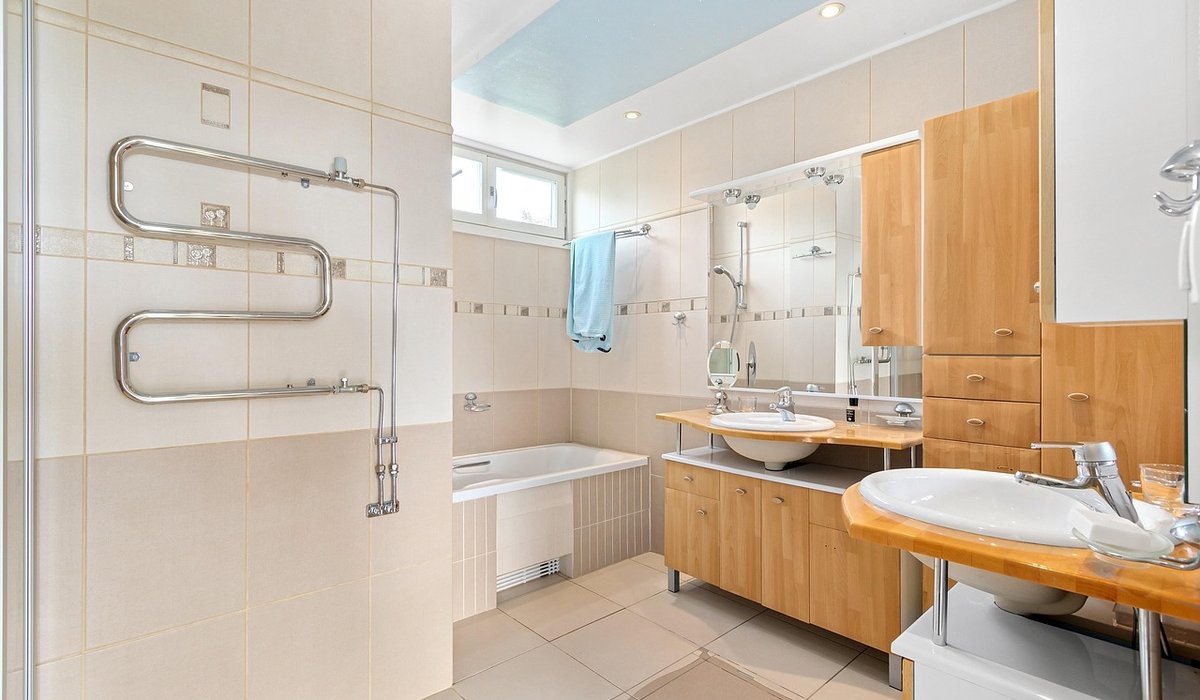
You do not have to commit to a single tone floor to ceiling. A half-tiled wall with a light upper section is a classic British solution, and it works because it pushes visual weight downwards, leaving the upper walls to reflect light. Tile to roughly 1.2 metres, or to 2.1 metres behind a shower, then paint above.
For low ceilings, consider painting the ceiling the same colour as the walls, or one shade lighter. Blurring that edge makes the room feel taller than a bright white ceiling floating above coloured walls, which draws a hard line exactly where you do not want one. In loft conversions with sloping ceilings, this trick is close to essential.
Where Bold Accents Belong
Bold colour has a place in a small bathroom — it just needs a job. Instead of a whole wall, put it on the elements that are already distinct: a single vanity unit, a painted basin cabinet, a panel of tiles inside a niche, a feature wall behind the mirror, or a deeply coloured blind. Used once, a rich navy, teal or aubergine becomes a deliberate focal point rather than a squeeze.
Keep bold accents away from the darkest corner of the room and away from the wall opposite the window, where they will absorb the light you are trying to preserve. A general rule worth following: if you can cover the accent with a bath towel, it is the right scale for a box room.
Grout, Tiles and the Details That Change Everything
Grout colour quietly rewrites a scheme. White grout with white tiles makes a wall read as one continuous surface, which is ideal in a tight shower enclosure. Darker grout on light tiles emphasises the grid, adding character but also visual noise — lovely in a larger bathroom, busier in a 1.7-metre-wide one.
Other finishes matter too. Large-format tiles mean fewer grout lines and fewer interruptions, so the eye travels further. A mirror wider than the basin reflects more of the room and effectively doubles it. And check your lighting temperature: bulbs around 2700–3000K will keep warm neutrals looking as they did on the paint chart, whereas cool white light will drag even a creamy white towards grey.
Testing the Scheme Before You Commit
Paint charts lie, and they lie most enthusiastically in small rooms with one window. Buy a tester pot, paint two generous A4-sized patches on different walls, and live with them for several days. Check them in morning light, under the bathroom bulb at night, and with the mirror light on.
Order one spare box of tiles — shades vary between batches, and a chipped tile five years from now is far easier to replace if you have a match in the loft. Finally, choose a moisture-resistant finish: a mid-sheen or eggshell bathroom paint wipes down easily around splash zones, while true matt looks softer but marks more readily. Get those foundations right and the colour will do the rest of the work for you.

4 Comments